Introduction
The evolution of computer technology is one of the most remarkable achievements in human history. Over the past century, computers have transformed from massive, room-filling machines capable of performing only basic arithmetic into sleek, pocket-sized devices and powerful quantum supercomputers capable of shaping the modern world.
Understanding this journey allows us to appreciate how far technology has come and where it is heading next.
1. The First Generation: Vacuum Tubes (1940–1956)
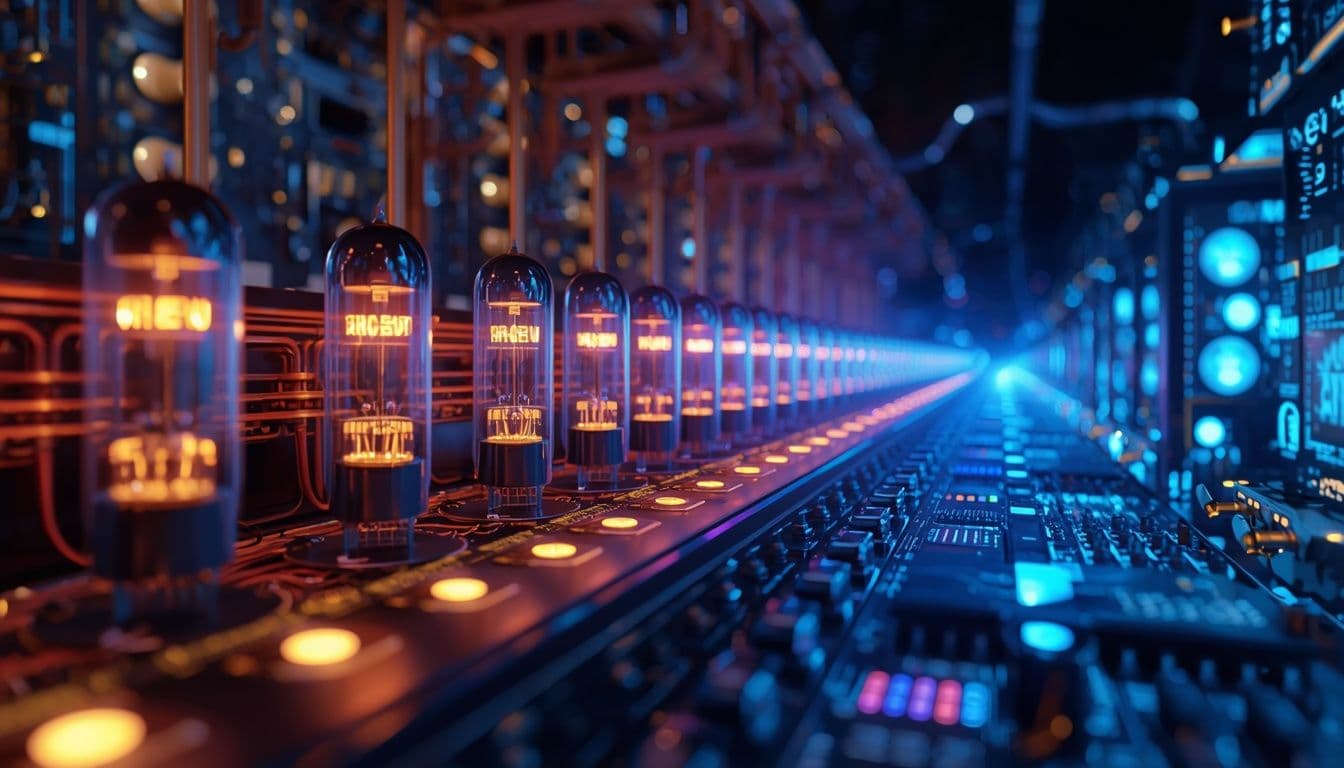
The foundation of modern computing was laid during the 1940s and 1950s. Computers of this era relied heavily on vacuum tubes as circuitry and magnetic drums for memory.
- Characteristics: These machines were colossal in size, often taking up entire rooms, and consumed massive amounts of electricity. They generated extreme heat and required air-conditioned server rooms to function.
- Programming: They were notoriously difficult to program because they relied on machine language (binary code of 0s and 1s).
- Key Examples: The ENIAC (Electronic Numerical Integrator and Computer) and the UNIVAC (Universal Automatic Computer) are prime examples of first-generation systems.
2. The Second Generation: Transistors (1956–1963)
The invention of the transistor revolutionized computer technology entirely. Transistors replaced bulky vacuum tubes, allowing computers to become smaller, faster, cheaper, and more energy-efficient.
- Characteristics: While still large by today's standards, second-generation computers generated far less heat and consumed less power than their predecessors.
- Programming: This era marked a shift from raw machine code to early assembly languages and high-level programming languages like FORTRAN and COBOL.
- Impact: Computers transitioned from strictly government and military applications into commercial businesses and universities.
3. The Third Generation: Integrated Circuits (1964–1971)
The continuous demand for smaller and faster machines led to the invention of the Integrated Circuit (IC). Instead of using individual transistors, engineers managed to place hundreds of miniature transistors onto tiny silicon chips, known as semiconductors.
- Characteristics: Computers became exponentially faster and more reliable. For the first time, users interacted with keyboards and monitors instead of punched cards, interfacing through operating systems.
- Accessibility: Because computers became significantly smaller and more affordable, they started entering offices and larger corporate environments.
4. The Fourth Generation: Microprocessors (1971–Present)
We currently live in the fourth generation of computing, defined by the microprocessor. This innovation brought the Central Processing Unit (CPU)—thousands of integrated circuits built onto a single silicon chip—into existence.
- The Personal Computer (PC): This era gave birth to the personal computer revolution, led by tech giants like Apple and Microsoft, making computers household items.
- The Internet and Mobile Era: The development of the internet, followed by smartphones, cloud computing, and modern wireless connectivity, connected billions of people globally.
- Artificial Intelligence: Today, fourth-generation systems are heavily driven by machine learning, big data analytics, and advanced artificial intelligence applications.
5. The Fifth Generation: Artificial Intelligence and Quantum Computing (The Future)
As traditional silicon chips approach their physical limitations in speed and miniaturization, computing is stepping into a revolutionary fifth generation.
- Quantum Computing: Instead of processing binary bits (0 or 1) like classical computers, quantum computers use qubits, allowing them to process complex calculations at speeds previously thought impossible.
- Autonomous Systems: Fifth-generation technology focuses heavily on advanced AI, neural networks, robotics, and autonomous systems capable of human-like reasoning and continuous self-learning.
Conclusion
The evolution of computer technology is a continuous story of human ingenuity. From the heavy, vacuum-tube-driven giants of the mid-20th century to the lightning-fast, intelligent, and interconnected systems of today, computers have redefined how we live, work, and communicate. As we stand on the threshold of the quantum and AI-driven era, the future of computing promises to unlock possibilities that we are only just beginning to imagine.
Related Articles:
Understanding Cloud Computing: A Beginner’s Guide
How to Secure Your Data from AI-Driven Cyber Attacks
Need Custom Software Development?
Got a project in mind or looking to scale your business with enterprise software, AI automation, or custom digital solutions? We are here to help!
👉 Contact Our Support Team and let's discuss how we can turn your vision into reality.